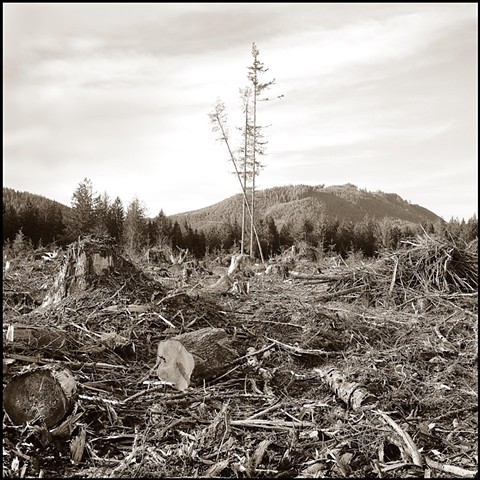
I see myself first as an artist. I have always felt compelled to use the medium that was best suited for my ideas and content. I don't feel that I have a loyalty to any one medium but have always loved using photography as elements in my work. I've recently been using photography as a primary medium because of its inherent acceptability as "truth." As an artist, I use this tool to exploit the subject, creating what I hope are images that generate an emotional response in the viewer.
Journals and diaries provide the source for projects and research. Patterns of daily activities and observations are recorded. Maps, drawings, photographs, and objects collected are incorporated in a layered story of our journeys to create texture and meaning in our diary-like works. Notes and ideas are synthesized with images into these artists' books and assemblages.
I really enjoy vintage cameras; they have a physical quality that a digital camera doesn't have. I find I gravitate to my Hasselblad 503 for its speed and reliability. If I happen to be trespassing on corporate property, I choose a camera that is super flexible and efficient. When I'm not trespassing to make images, I often will use a variety of other cameras, ranging from vintage bellows cameras to large-format cameras.
I heard Ralph Nader speak, and something he said I never forgot. He spoke about using your talent, whatever it was, being an artist, a poet, a lawyer, a journalist, to fight back against the injustice that you see. I found that very powerful, and it's one of the things that has always guided my art making. Gordon Parks said, "A camera is a weapon against poverty, racism, and discrimination. The camera could be used to expose injustices and bring about change in what we witness. I feel we have a moral obligation to do so."
I feel lucky to have a lack of fear when it comes to making art. I have never feared making a failure. If I become interested in a subject or process, I tend to gravitate toward exploring it. I often feel like I'm on a quest for constant learning. Failure or things not coming out just the way I imagined them is not often a worry, but part of an overall discussion on how to get to what I'm looking for. Sometimes, in the mistakes, there are places for new ways of interpretation to happen.
Tony Bellaver is a Bay Area photographer and mixed media artist specializing in experimental photographic techniques. Between 1985 and 1986, Bellaver served as a darkroom assistant at the Ansel Adams works shops in Yosemite for Charles Crammer who taught Cibachrome printing and dye transfer printing, before receiving his undergraduate degree at San Jose State University, and graduate degree at the San Francisco Art Institute (SFAI). While in graduate school, Bellaver expanded his vision of art, focusing on work that incorporated photographic elements using alternative photographic processes.
Since graduating from SFAI, his artwork has been exhibited at Yerba Buena Center for the Arts, DeYoung Museum of San Francisco, and he has had work shown by Patricia Sweetow Gallery, Los Angeles; Seager Gray Gallery, Mill Valley; and Steffany Martz gallery, Chelsea. He and his partner Mary live and make their art in Oakland also working collaboratively as Quite Contrary Press with their border collie Luna.